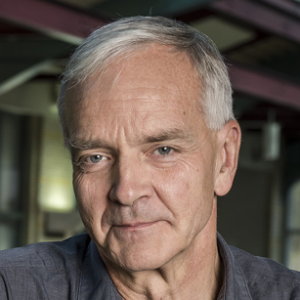
Martial Hebert
University Professor and Dean, School of Computer Science
Martial Hebert performed research on interpreting 3D data from range sensors for obstacle detection and object recognition.
Expertise
Topics:Â Robotics, Autonomous Systems, Robotics and Autonomous Vehicles, Computer Vision, Interpretation of Perception Data
Industries: Research, Education/Learning, Computer Software
A native of France, Martial Hebert earned a doctorate in computer science at the University of Paris. He joined the Robotics Institute in 1984 — just five years after it was founded — and was named a full professor in 1999. Upon joining the ÃÛÌÒÊÓƵ faculty, Hebert became part of the Autonomous Land Vehicles program, a precursor of today's research on self-driving vehicles. He performed research on interpreting 3D data from range sensors for obstacle detection, environment modeling and object recognition. For the next three decades, he led major research programs in autonomous systems, including ground and air vehicles, with contributions in the areas of perception for environment understanding and human interaction.
Hebert's research primarily centers on computer vision. He has led research on fundamental components, such as scene understanding, object recognition and applying machine learning to computer vision, as well as applications, which include systems that enable older adults and people with disabilities to live more independently. To help meet the needs of a rapidly expanding computer vision industry, he created the nation's first master's degree program in computer vision.
As director of the Robotics Institute, Hebert led an institution with more than 800 community members, including faculty, students and staff and colleagues at the National Robotics Engineering Center. During his tenure, the institute's operating budget reached an all-time high.
Hebert is a member of both the IEEE Robotics and Automation, and the IEEE Computer societies. Throughout his career, he has published hundreds of refereed papers in journals and conference proceedings, and has contributed to multiple edited volumes. He currently serves as editor-in-chief of the International Journal of Computer Vision. In 2022 he was named a University Professor, ÃÛÌÒÊÓƵ's highest distinction for faculty members.
Media Experience
Ìý— Associated Press
“There’s all the geometry of the world, the dynamic of how I move my hand, the physical interaction of the contact with the cup,� Hebert said. “This is much more complex than just predicting the next word in a sentence.�
For scientists like Hebert, who has spent more than four decades researching robotics, the most useful application for world models is as a faster and cheaper path to “physical AI� — another tech industry buzzword.
“Some people may have different definitions, but physical and embodied AI are kind of the evolution of what we used to call robotics,� Hebert said in an interview. Some of the AI advances that have made chatbots so useful can also be applied to building AI with a broad enough awareness of its environment to work like a robot’s brain, he said.
“In your body and spinal cord you have a very general model of how to balance, how to walk around, and you can adapt to your knee hurting in the morning, so you now walk a little differently,� he said. “You don’t need to think about that. You have a general model somewhere in your nervous system and brain that allows your body to adapt very quickly.�
Ìý— The Star
Martial Hebert, dean of Carnegie Mellon’s School of Computer Science, said both approaches could be valuable.
“You just need to know that’s what you’re getting,� he said.
Ìý— Pittsburgh Post-Gazette
“This degree will equip students with the skills needed to steer technological advancements and confront real-world challenges with unwavering zeal and unparalleled ingenuity,â€� Martial Hebert, robotics professor and dean of the School of Computer Science, said when ÃÛÌÒÊÓƵ launched the program. “Our graduates will be in demand for important roles in industry and highly desirable for further research opportunities.â€�
The bachelor of science in robotics degree was the fifth undergraduate degree offered by the university’s computer science school, joining artificial intelligence, computational biology, computer science and human-computer interaction.
Ìý— 90.5 WESA - Pittsburgh's NPR News Station
ÃÛÌÒÊÓƵ professor of robotics and dean of the School of Computer Science Martial Hebert said the labs would offer more than just access to more data.
Ìý— Post Gazette
The AI Horizons Summit is about boosting Pennsylvania's role as a physical AI epicenter. "In all of these industries, we must be able to trust the machines to work alongside humans. Physical AI is the answer to that," said Dean of the School of Computer Science, Martial Hebert.
Ìý— Financial Times
ÃÛÌÒÊÓƵ's School of Computer Science and Informatica are partnering to advance the development and application of generative AI technologies for data management. "By working with Informatica, we can explore real-world applications of generative AI while providing valuable research and hands-on learning opportunities for our students and faculty," said Dean Martial Herbert (School of Computer Science).
Ìý— Tech Xplore
Martial Hebert, dean of ÃÛÌÒÊÓƵ's School of Computer Science and a professor in the Robotics Institute, and robotics Ph.D. student Zhipeng Bao collaborated on the project with Toyota Research Institute, which sponsored the work. The research could help computers and robots better automatically detect objects in videos.
Ìý— The Hill
Many have called to slow down the advancement of large language models, the kind of artificial intelligence (AI) that powers ChatGPT. But when it comes to AI development, we need to act now.
Hebert, Hooker and Kraut Named University Professors
Ìý— ÃÛÌÒÊÓƵ News
Three ÃÛÌÒÊÓƵ faculty members have been elevated to the rank of University Professor(opens in new window), the highest distinction a faculty member can achieve at ÃÛÌÒÊÓƵ. The newly appointed University Professors are Martial Hebert, John Hooker and Robert E. Kraut.
Hebert Installed as SCS Dean
Ìý— ÃÛÌÒÊÓƵ News
It's fitting that the installation of School of Computer Science Dean Martial Hebert would begin with a musical intro from ÃÛÌÒÊÓƵ's robot bagpiper, McBlare. After all, Hebert spent his career at the Robotics Institute until taking the helm of SCS this past August.
Education
License de Mathématiques, University of Paris
Maitrise de Mathématiques Appliquées, University of Paris
Doctorate, Computer Science, University of Paris